
A Republic within the Republic
Re-reading Sartre in the age of Trump

We are spending a couple of weeks in France. The first week we were in Paris. I presented a paper at the big “Derrida Today” Conference at the iconic École Normale Supérieure. (Including mine, there were four papers putting Derrida and Hegel back into conversation, all by young scholars, which I count as intriguing.) Given the heat, we fled the capital a day earlier than planned to extend our time, now, in the south of France.
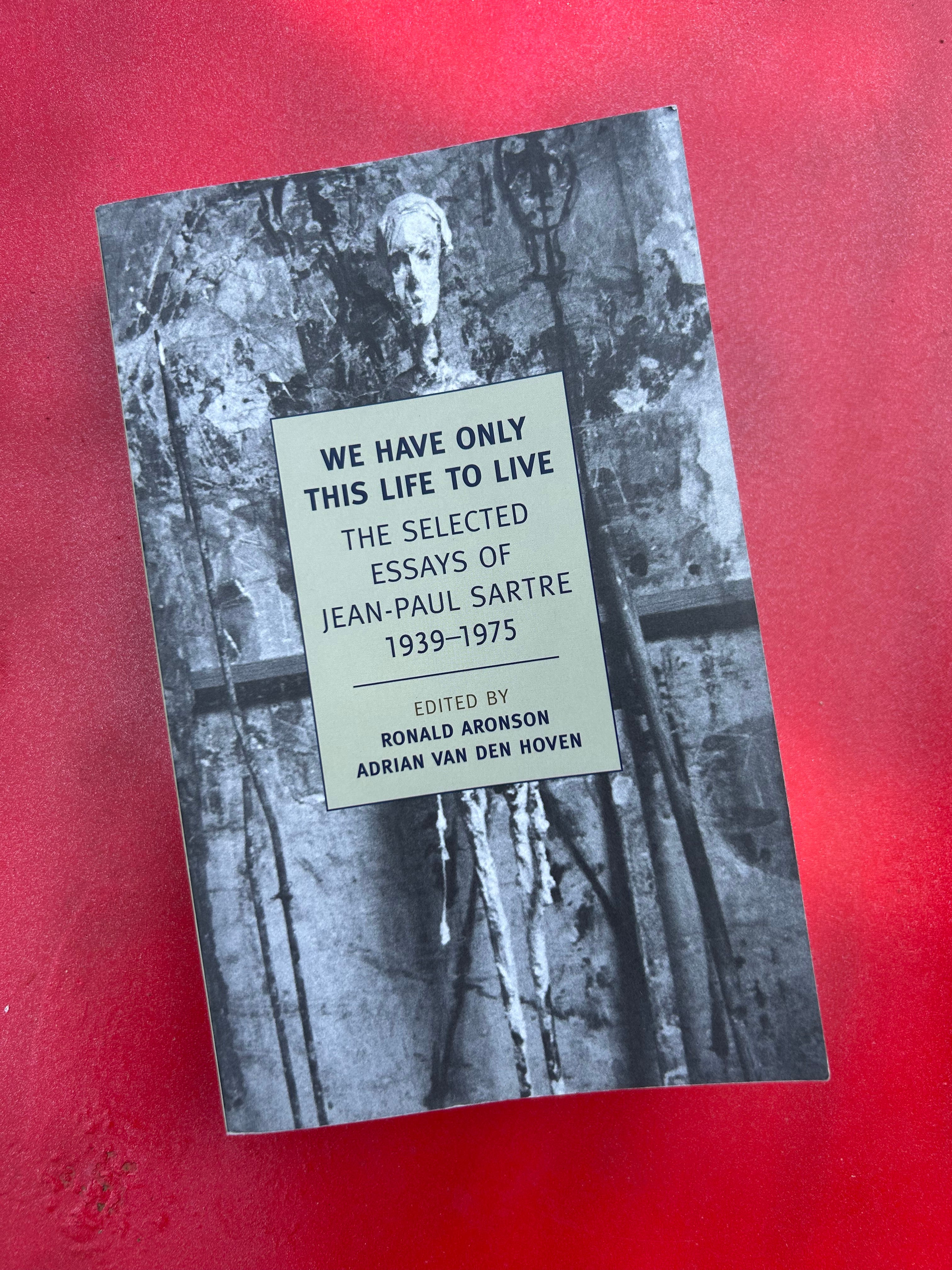
I know some of you will sympathize when I say that one of the biggest stressors of preparing for a two-week sojourn is selecting which books to pack! Deanna and I both love to bring reading that embeds us in the context of where we’ll be. In addition to a volume of Hegel (Faith & Knowledge) and Schleiermacher’s On Religion: Speeches to Its Cultured Despisers (in preparation for a new book project), I selected three volumes for pleasure: Lisa Robertson’s Riverwork (absolutely stunning—I will have to say more later), The Collected Stories of Mavis Gallant (Canada, Paris, and the south of France all rolled into one!), and We Have Only This Life to Live, a marvelous collection of Jean-Paul Sartre’s essays and criticism published by NYRB Classics.
By the time I was in graduate school studying French philosophy in the 1990s, Sartre was already passé. (I suspect Derrida felt the same to young scholars studying in the 2010s.) Sartre and Camus lived on in undergraduate courses in “Existentialism and Phenomenology,” but this all had the musty whiff of recent history—what used to be edgy and provocative but now settled into a comfortable place in the curriculum. There was nothing left to surprise us; the canon was closed.
We were wrong about this, of course. We’re always wrong about the recent past, especially theorists and theory, perhaps. It’s as if we have to let thinkers become petrified and passé so that they can then be revisited and excavated afresh by readers in the next generation. (I feel like that was some of what was happening at the Derrida conference last week; I was quite struck by how remarkably young the participants were. A sign of re-discovery? These young readers returning to the text have something to teach us fiftysomethings.)
Returning to Sartre today is bracing. Here is philosophical prose that is alive, ambitious, even brash. This collection includes works of criticism (e.g., illuminating readings of Camus’ The Stranger and Bataille’s Inner Experience) and philosophical essays; but it also includes Sartre’s journalism, including a fascinating series of reports from the U.S. in 1945, with a particular focus on the state of the American working class, such as it is (which is…not!). These reports take on new valence in a moment where there is some furtive hope for socialist candidates in U.S. electoral politics right now. Sartre is at first puzzled and then unsurprised when he realizes that even organized labor in the U.S. is opposed to socialism (the AFL & CIO, he notes, are both “in favor of extracting the most from free enterprise”). “Marxism,” he reports in 1945, “about which the immense majority of Americans don’t know the first thing, is America’s bogeyman.” This, he documents, is because of all the ways U.S. capitalism hides class structure and division. We are all so “optimistic,” that we would rather believe we could be the 1% (Tomorrow! Tomorrow!) than dismantle a system that keeps creating a 1% that ascends further and further into the stratosphere. The political economy of the U.S. is a lottery that calls itself “freedom.” Workers operate on the false hope—built into the “American Dream”—that they can beat the house. This, says Sartre, is why there’s no proletariat in the U.S. When it comes to the American “worker,” “the plunder occurs with his consent.”
Included in this collection is also Sartre’s much-anthologized essay, “The Republic of Silence,” which begins with this notorious line, oft misunderstood:
Never were we freer than under the German occupation.
With nascent fascism percolating in the U.S. again, this searing essay takes on a renewed urgency. In the face of “smartly dressed torturers,” the choice to be human is presented starkly. “Is not this total responsibility in total solitude the very revelation of freedom?” Under the conditions of occupation arose a “Republic of Silence and Night”: “in the shadows and in blood, the strongest of Republics was forged. Each of its citizens knew he had an obligation to all and that he had to rely on himself alone.” This “Republic without institutions” would be the matrix for another Republic. Do we not face the same choice?
In case you’ve never read Sartre’s essay, or haven’t read it in a while, I here share it as a kind of intellectual public service.
The Republic of Silence
By Jean-Paul Sartre
We were never more free than during the German occupation. We had lost all our rights, beginning with the right to talk. Every day we were insulted to our faces and had to take it in silence. Under one pretext or another, as workers, Jews, or political prisoners, we were deported EN MASSE. Everywhere, on billboards, in the newspapers, on the screen, we encountered the revolting and insipid picture of ourselves that our oppressors wanted us to accept. And, because of all this, we were free. Because the Nazi venom seeped even into our thoughts, every accurate thought was a conquest. Because an all-powerful police tried to force us to hold our tongues, every word took on the value of a declaration of principles. Because we were hunted down, every one of our gestures had the weight of a solemn commitment.
The circumstances, atrocious as they often were, finally made it possible for us to live, without pretense or false shame, the hectic and impossible existence that is known as the lot of man. Exile, captivity, and especially death (which we usually shrink from facing at all in happier times) became for us the habitual objects of our concern. We learned that they were neither inevitable accidents, nor even constant and exterior dangers, but that they must be considered as our lot itself, our destiny, the profound source of our reality as men. At every instant we lived up to the full sense of this commonplace little phrase: “Man is mortal!” And the choice that each of us made of his life and of his being was an authentic choice because it was made face to face with death, because it could always have been expressed in these terms: “Rather death than…” And here I am not speaking of the elite among us who were real Resistants, but of all Frenchmen who, at every hour of the night and day throughout four years, answered NO.
But the very cruelty of the enemy drove us to the extremities of this condition by forcing us to ask ourselves questions that one never considers in time of peace. All those among us – and what Frenchman was not at one time or another in this situation who knew any details concerning the Resistance asked themselves anxiously, “If they torture me, shall I be able to keep silent?” Thus the basic question of liberty itself was posed, and we were brought to the verge of the deepest knowledge that man can have of himself. For the secret of a man is not his Oedipus complex or his inferiority complex: it is the limit of his own liberty, his capacity for resisting torture and death.
To those who were engaged in underground activities, the conditions of their struggle afforded a new kind of experience. They did not fight openly like soldiers. In all circumstances they were alone. They were hunted down in solitude, arrested in solitude. It was completely forlorn and unbefriended that they held out against torture, alone and naked in the presence of torturers, clean-shaven, well-fed, and well-clothed, who laughed at their cringing flesh, and to whom an untroubled conscience and a boundless sense of social strength gave every appearance of being in the right. Alone. Without a friendly hand or a word of encouragement. Yet, in the depth of their solitude, it was the others that they were protecting, all the others, all their comrades in the Resistance.
Total responsibility in total solitude – is this not the very definition of our liberty? This being stripped of all, this solitude, this tremendous danger, were the same for all. For the leaders and for their men, for those who conveyed messages without knowing what their content was, as for those who directed the entire Resistance, the punishment was the same – imprisonment, deportation, death. There is no army in the world where there is such equality of risk for the private and for the commander-in-chief. And this is why the Resistance was a true democracy: for the soldier as for the commander, the same danger, the same forsakenness, the same total responsibility, the same absolute liberty within discipline.
Thus, in darkness and in blood, a Republic was established, the strongest of Republics. Each of its citizens knew that he owed himself to all and that he could count only on himself alone. Each of them, in complete isolation, fulfilled his responsibility and his role in history. Each of them, standing against the oppressors, undertook to be himself, freely and irrevocably. And by choosing for himself in liberty, he chose the liberty of all. This Republic without institutions, without an army, without police, was something that at each instant every Frenchman had to win and to affirm against Nazism. No one failed in this duty, and now we are on the threshold of another Republic. May this Republic to be set up in broad daylight preserve the austere virtue of that other Republic of Silence and of Night.