
Stop Looking for the Light: Listen to the Dark
Attending to the present with the mystics

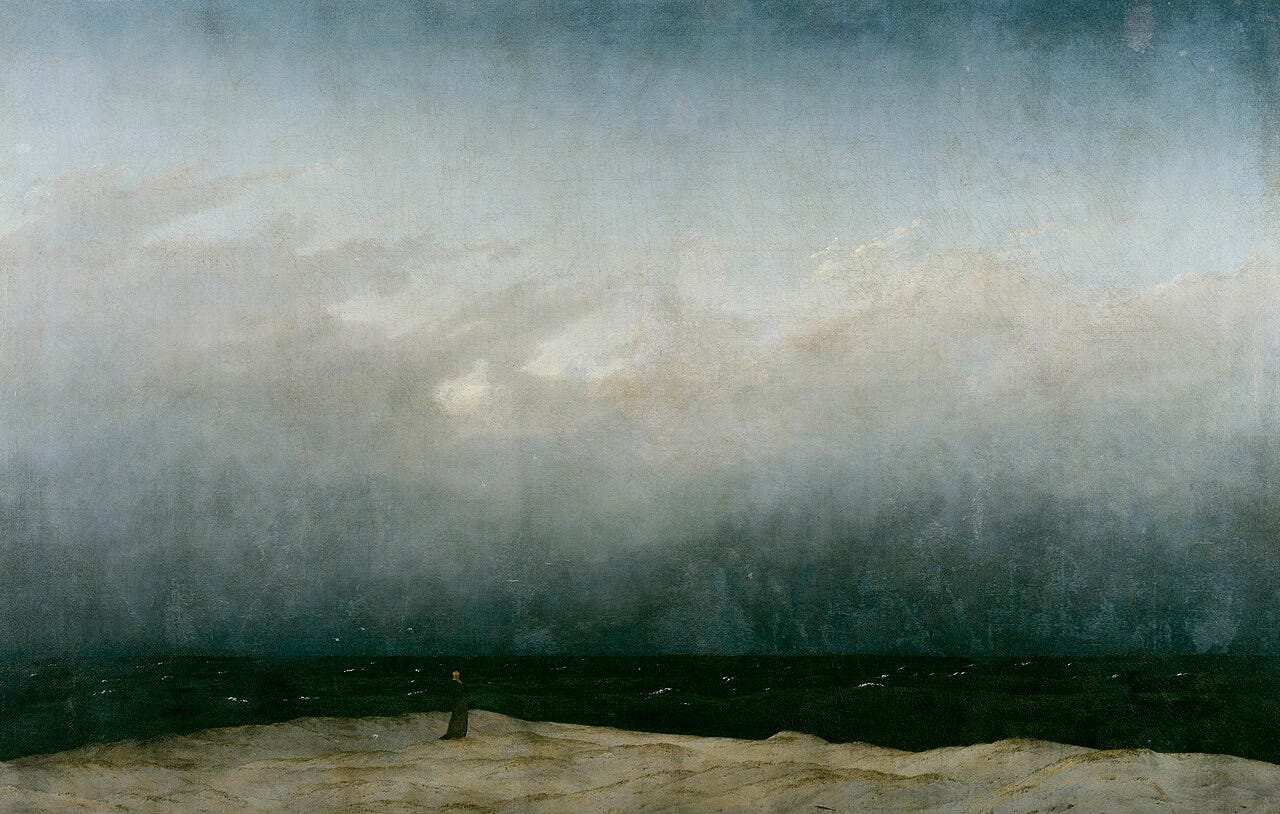
These are dark days for the Republic. Bombings in the night. Executions in broad daylight. Hatred as policy. Propaganda that obscures. The maddening impenetrability of disinformation. Authorized obfuscation. A pall is draped over our collective consciousness.
All this darkness fits, somehow, with the sun-starved days of winter. We live with little light. We go to work in the dark and return home after the sun has set. The caverns between skyscrapers are dimmed in late afternoon. In January, even the daylight sky is often a tenebrous pewter ceiling.
So we chase the light. Some fly south. Some install lamps that mimic sunlight. Many pine impatiently for lengthening days. Most long for summer’s brilliance.
We yearn for the same in our collective national life. “Democracy dies in darkness,” as the Washington Post puts it. We want clarity, transparency, enlightenment. We want to understand. In our most common metaphor, to know is to see. And seeing requires illumination.
And yet, somehow, incessant waves of information haven’t dispelled the shadows. In a fitting irony, the so-called “disclosures” of the Epstein files were awash in pages of blacked-out redactions. We’ve unleashed machines that flood our digital lives with fakes—the irony of pixelated darkness. The glow of digital feeds on our phones is, more and more, a shimmer of obfuscation.
What if, instead of chasing the light, we got curious about the dark? What if we stopped pining for the summer sun and listened to the dark? What if the dark is a door to a different sort of discovery? What if there is a strange sort of “revelation” that is almost the antithesis of “enlightenment?” What if winter—even this winter of the Republic—is an invitation to make our home in shadows?
This is the surprising lesson I learned from mystics like St. John of the Cross and St. Teresa of Ávila. You might think of mystics as people defined by epiphany, blinded by the light. But, in fact, all of these mystics testify to the luminosity of the dark.
The medieval author of The Cloud of Unknowing offers strange counsel, for example:
“Make your home in this darkness. Stay there as long as you can.”
Something happens in the dark, the mystics attest, that can only happen there. It’s not that the darkness is simply a prelude to light. Their counsel is not to be patient until the sun comes back. Rather, the mystics suggest that darkness has something to teach us. When we are “in the dark,” we lack the mastery and control of knowledge. This vulnerable vertigo of un-knowing, the mystics counsel, harbors the potential for liberation. What we learn in the dark is how to let go.
Darkness is a place of un-doing. But that makes it a place of possibility. Imagine the darkness of a womb: new birth is possible. You just have to let go of all you’ve learned to expect. The lesson of darkness is a kind of un-learning that begets liberation. Stop approaching darkness as absence; imagine darkness as pregnant with possibility.
The Rhineland mystic, Meister Eckhart, evokes the womb-like dark. The new you—your rebirth—“begins in the darkness of unknowing when you have relinquished all that you understand; only when you have abandoned your knowing and willing can God shine forth within you.” Whatever your relationship to faith, consider “God” as Eckhart’s name for a radically different possibility of being. The new you, he says, is only born in the dark. “You’re never closer to God,” he says elsewhere, “than when you are in utter darkness and unknowing.”
This is why the descent of darkness can be a portal, a door, an opening. Eckhart, reflecting on Saul of Tarsus’ encounter with blinding light on the road to Damascus, notes that in this moment, Paul is plunged into darkness. With his fall, “he began to see all things as nothing. Only when he rose from the ground, blinded, was he finally able to see God.”
So, now, I try not to run too quickly from the dark. I make my home there and stay as long as I can. I let go of my penchant to see and know—to control and master—and sit quietly, waiting to receive new possibilities rumbling in the dark. You can imagine how this feels. Indeed, you may have awoken this morning maddened by all this surrounding dark. Like me, you might find yourself, by turns, livid and sad, enraged and despairing, confused and angry. I want to do something; I need to do something; I need to assure myself and the world that I know what’s going on. I want the floodlights lit. I want to light them.
But there is a darkness that is impenetrable. I try to sit with all of this, in the dark, and not rush to resolve it. There is a sort of awareness available in darkness that is deeper than the knowledge available in the light.
This is not an escape from the world or a retreat from reality. To the contrary, the mystics testify. Something happens in me and to me when I make my home in the dark. From this humbling—even humiliating—experience of dwelling in the dark, new capacities are born, as if my soul is opened and unfolded in new ways. It is in darkness that compassion is born.
In the darkness we are all vulnerable. We are all fumbling about, reaching out. Without light, we have to feel our way around. Hands reach back. To clasp hands in the dark is to find a solidarity that’s hard to imagine in the pixelated environs of our rage. Huddling together in the dark almost feels like a place where a Republic could be reborn.
I have much more to share about these experiences and lessons from the mystics. That’s why I wrote my new book, Make Your Home in This Luminous Dark: Mysticism, Art, and the Path of Unknowing, which will be released on March 24. Watch this space soon for updates on a book tour that will take us to New York, Austin, Denver, and my home here in Grand Rapids—and (hopefully, in the works) DC, Los Angeles, Boston, and elsewhere.