
Finding an audience? Or evoking an audience?
Musings on writing with St. Anthony of Padua

In the interim before our spring semester begins, my wife and I have enjoyed the opportunity to make a retreat at an enchanted place in the Texas Hill Country that we have visited many times. What’s special about being here for a more extended time are the quiet days, between weekend retreats, when it feels like we have this vast, cavernous valley all to ourselves. Cliffs climb above us in majestic silence; the sun glints off ripples on the Frio River, somehow emerald green; and at night, miles and miles from any urban center, the sky is agleam with brilliant stars.
There is something almost monastic about the rhythms we adopt, our days stripped down to eating, reading, reflection, and prayer. We arrived with questions to be faced, decisions to be made, uncertainties we needed to grapple with. We gave each other space for personal reflection and then came together to share what we were sensing, what was percolating, how we felt led. It has been a dance of centrifugal solitude and then centripetal encounter. It is an incredible gift to receive the time & space to do this sort of soul work with a partner you can trust. Our time has been fruitful and I am grateful.
The arts are an integral part of this retreat center. There are two art studios on site, every weekend retreat features a concert, and each retreat offers a creative/artistic opportunity in the afternoons, led by an artist in residence for the weekend. After last weekend’s retreat, the artist kindly left me some of the materials for the project in case I wanted to try my hand at something creative in this quiet week of reflection.
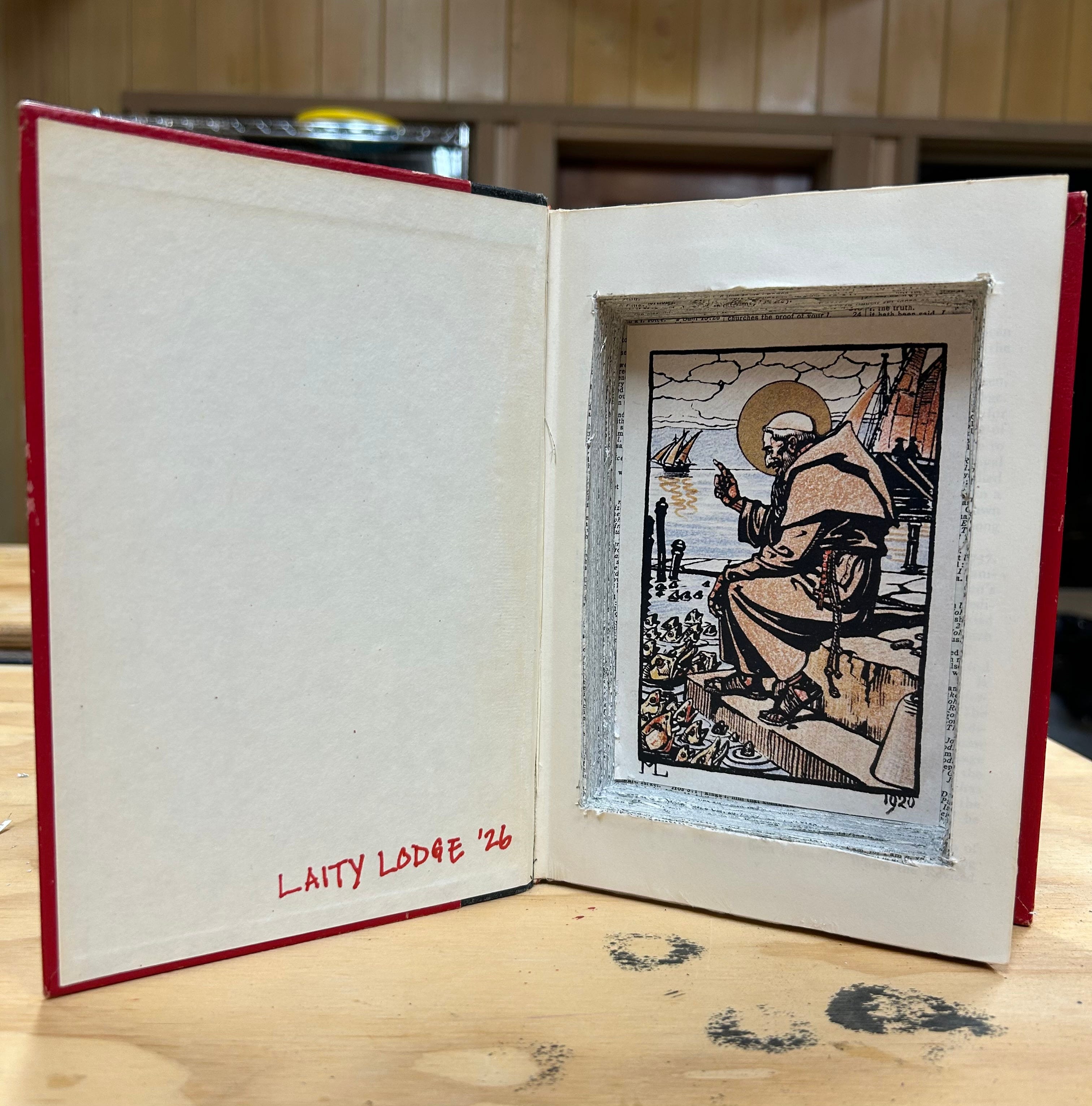
He had brought a bunch of discarded library books, glued the pages together, and then provided tools for us to “carve,” as it were, a cavity in the book in which we could then place an image. Everyone, I gather, felt an initial discomfort cutting into a book (my heart is racing as I even type that)! The fruit of the project was a miniature shrine, of sorts—a kind of icon corner framed by word (but also, I guess, the destruction of word!).
The book left for me was an old battered copy of Cruden’s Complete Concordance. Its dense, onion-skin pages had the feel of a Bible, adding to my initial reservations. But I began to dig my way into its paper guts, layer by layer, extracting first the As, then the Bs, etc. I dug down to the Ls and decided I would stop at the page that featured LOVE.
Then I selected my image: a woodcut (I’m ignorant of its provenance) of St. Anthony of Padua preaching to the fishes. What drew me to this image?
If you don’t know the tale (fabulous, no doubt), the basics of the story are these: St. Anthony, that silver-tongued Franciscan preacher, ventures to the coastal town of Rimini to proclaim the Gospel and call its inhabitants back to God. The leaders of Rimini are not just uninterested but hostile. They tell everyone to ignore Anthony. He was greeted by only disdain and silence. So he turned to the mouth of river and preached a sermon to the only ones in Rimini who would listen: the fish. At his words, the fish gather, heads bobbing above the water, as if nodding in agreement. A hungry audience.
Drawn to this image, I got thinking about the sort of writer I want to be. Do I want to be the sort of writer who’s gladly received in Rimini, as long as I tell them what they want to hear? Or would I rather write what I feel compelled to write, and hope the fishes find me?
St. Anthony clearly failed to do his marketing research in Rimini. There are so many forces in contemporary publishing that keep nudging authors to appeal to a “market,” an existing “audience” already waiting for a certain kind of book. Agents will tell you who they are and what they want. Publishers think they know who they are and what they want. And not a few authors are writing the books that they think will be bestsellers in Rimini. (There’s also a lot of money to be made, I gather, by being decidedly anti-Rimini. There’s a huge market for the ex-Rimini memoir, it turns out.) The formula is easy enough to see; this is writing as algorithm.
I can’t imagine writing a book in this way—to fill a market niche. (Granted, this might explain my sales?)
I think this is what I love about St. Anthony: he doesn’t settle for an existing audience; he makes one. He doesn’t “find” an audience; his oratory evokes an audience.
I know that I write sorta weird books. They are books that fall between the cracks, a little bit. They are sometimes a little too philosophical for general readers, but also way too personal and “engaged” for academics. I don’t know that my last few books really fall into a delineated genre. I’m not sure how to identify my “audience” except to say, with profound gratitude, that a wonderfully weird amalgam of people seem to find their way to my books.
And I can’t imagine not having written those books. These were the books burning in my belly. These were the books I needed to write to wrestle with my demons. These were the books I needed to write to try to understand something about the world, history, myself, and God. The idiosyncrasy of each of them is a signature of a vocation and a calling: I’m trying to inhabit this strange space, passionate about philosophy because I think it can change your life—maybe even change the world.
This, it turns out, is not everyone’s cup of tea. Fair enough.1 My fishes will find me. That, too, is a miracle. And I’m grateful.
By the way, my next book—Make Your Home in This Luminous Dark: Mysticism, Art, and the Path of Unknowing—arrives in your favorite bookstore on March 24. It’s never too early to pre-order. Thanks for reading!
Though, Oprah, if you’re listening: I really think you’d love the next book. 😇