
Ode to a Lost Notebook
Further lessons in letting go

I was jolted awake, disoriented.
Trying to muster coherence, I heard a calm German voice announcing our arrival in Zurich. Reality was coming back to me. I was on a train from Biel to Zurich airport, ending a whirlwind trip to Switzerland in a heatwave. I had fallen sound asleep and awoke at my destination.
I scrambled to gather up my things. I stuffed my book and iPad into my backpack, grabbed my suitcase, and hustled off the train. I navigated the transition from train station to airport, checked in, nabbed the obligatory Lindt & Toblerones for the family from the Duty Free shop, then sat down for a cappuccino, hoping to finish the draft of a chapter I had been writing on the train.
Only then did I realize: in my flustered scramble to get off the train, I had left a notebook behind. When I fell asleep, it must have nestled into a fold in my seat and escaped my harried attention when I awoke.
The bottom fell out of my stomach. I am sure that my shoulders visibly collapsed. I must have been the very picture of the Ben Affleck meme (minus the hair and the jawline and really, really wishing I had the cigarette).

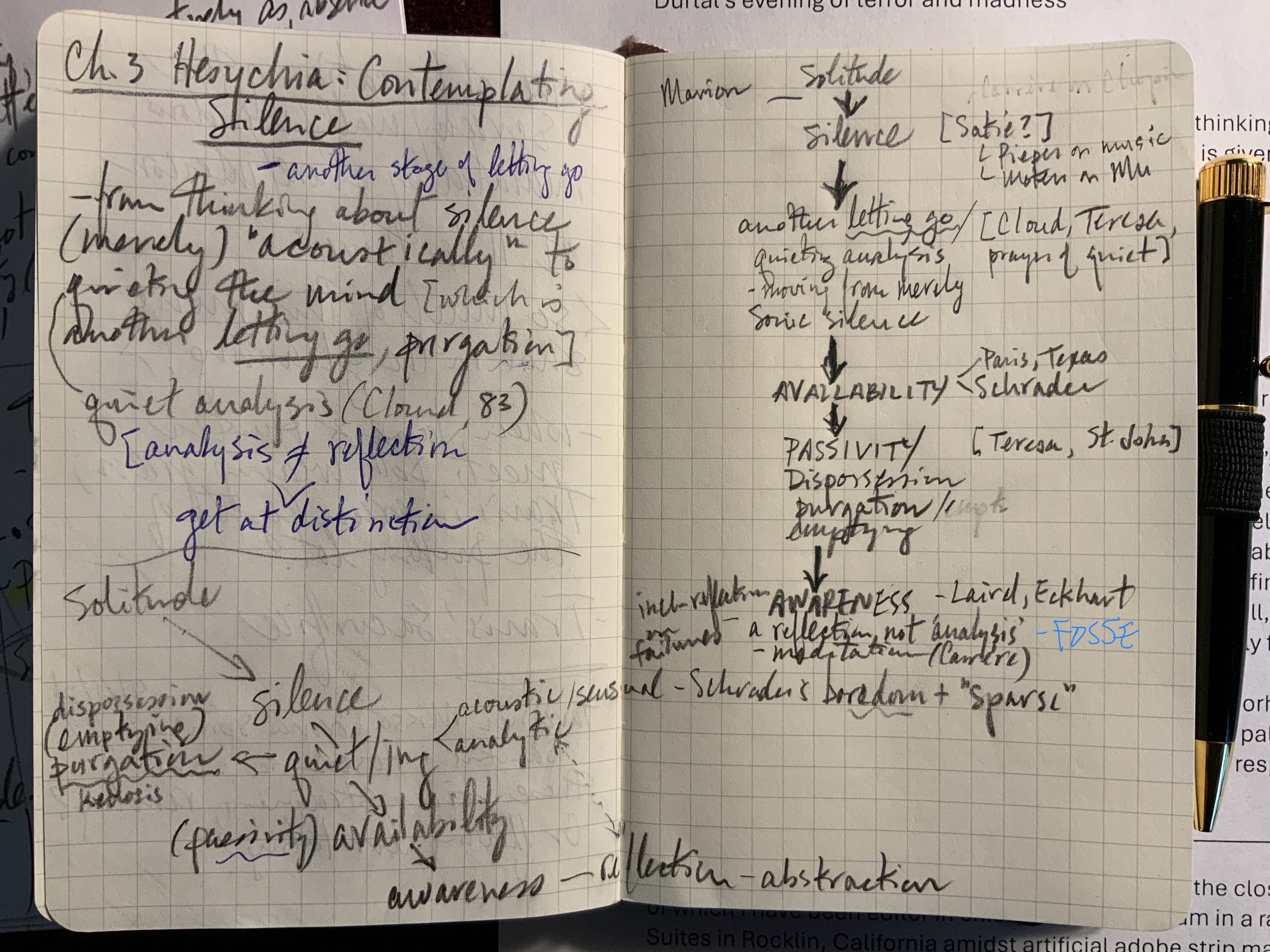
If you’re a writer, you might be able to imagine how crestfallen I was. The notebook1 held over two years’ worth of musings, scribblings, notations, and dreaming—two years of reflection, introspection, and lament. In it were notes in which I was beginning to work out at least three new book ideas, along with the fruit of two years of reading in both primary texts and secondary literature. The journal included notes on visits to multiple museums, art exhibits, and film screenings, the record of my observations and emotional reactions, all fodder for who knows what in the future. It was hard not to think that a piece of my life had been left behind on that train.
Mirabile dictu, I did not cuss. Or cry. After an audible sigh, and then a deep cleansing breath, I was kind of surprised how quickly I was able to let it go.
It’s funny, actually. A testament to my Bible-college education, it’s crazy how quickly I recalled the travails of the Hebrew prophet, Jeremiah, who dictated an entire scroll, only to have King Jehoiakim burn up the entire thing, and Jeremiah had to start over. I suppose I took some strange encouragement from the fact that, when Jeremiah did the whole thing over, “many similar words were added to them” (Jer. 36:32). Maybe loss is gain?
I am, no doubt, going to be working on something in the coming weeks and will, by force of mental habit, reach for earlier notes and be reminded they’re lost. I will feel the loss afresh. But I’ve been a bit surprised by my own calm about this loss. And so I’ve gotten curious about my rather zen composure.2
First thought is simply: mental health makes a difference. Seriously. My forty-two-year-old self would have lost his sh*t. And everyone around me would have paid for it. I would have been frantically worried that my career was over. This lost notebook would have been freighted with every other unarticulated loss in my life and would have become the totem of my deeper existential despair. Three cheers for counseling and fifty-something maturity!
I think another reason I haven’t been devastated is tied to one of the reasons I keep a physical notebook in the first place.3 I firmly believe that inscribing ideas with pen and paper is not just archival—prosthetic memory—but also generative. In other words, I think scribbling things down and marking up the page and drawing lines to connect-the-dots is its own form of thinking. And having done that (physical) thinking, the thought also stays with me in a new way, apart from its record on the page. The idea is mine because I’ve jotted down and worked it out, even if I don’t have the paper.
This is a new sort of epistemic trust I’ve been trying to practice over the past decade. A younger me was fastidious about preserving every scrap on which I had jotted down an idea or harnessed a thought, as if my thinking had been off-loaded to the material archive of my notes and now, to keep the ideas, I had to hoard the paper. But I’ve realized that the process of writing actually inscribes the thinking in me, and so I’ve tried to let go of the anxiety of preservation and come to trust that the ideas are being worked out in me and that they’re a part of me that I can access when I’m creatively engaged. I half wonder if the loss of the notebook isn’t a little test of my epistemic trust in this regard (yes, that Bible-college education did a number on me).
One last thought. My lost notebook included pages and pages of writing I call “journaling.” This is a practice I learned in therapy, and it is something that my wife, Deanna, often encourages when she can see dark clouds beginning to form in my eyes. Something’s going on, babe, she’ll say. Why don’t you make some time to journal? It is a physical ritual for introspection. I think by writing, so journaling is—cliché be damned—a way of processing something inchoate and stirring. There’s an act of naming here: naming emotions, fears, anxieties, laments. Sometimes “journaling” is just honest description of a situation, giving myself permission to name what (or who) has disappointed me. Sometimes it is a form of excavation: sitting introspectively long enough to see the monsters surface from the subterranean lakes of my unconscious; often enough they begin to dissolve as soon as they break through. Sometimes journaling is a physical act of wondering, or imagining possible scenarios, whether my worst fears or latent dreams.
Over the past two years with this particular notebook, I had “journaled” my way through some of my most difficult professional disappointments and disillusionment. I went through a season of profound disorientation; there were months I felt abandoned and adrift. Most of it was about profound alienation from the institutions in which I had invested myself. I am not ashamed to say there were multiple nights of tears. I am profoundly grateful for a partner who meets me in these spaces and shares the volatile work of discernment and healing. I’m also grateful for a community that gave us space to retreat for a time of world-changing, soul-saving discernment. Through all of this I was journaling in this notebook, working out just how and why I was so profoundly disappointed, why I felt so betrayed, what I could hope for on the other side, at least when I could glimpse it. (This might be something I write about more substantively at some point; we’ll see.)
January 2026 was a watershed in this journey and I have been at profound peace since that time.4 External circumstances haven’t really changed but the process accomplished a kind of soul-change that I carry with me. Much of that soul-work was worked out in the lost notebook. But letting it all go seems right—like writing one’s griefs on tiny paper boats and setting them adrift on the sea. Gelassenheit, Meister Eckhart called it. A letting go that yields freedom. The loss that is gain. The less that is more. The contraction that dilates the heart.
I didn’t leave my mind or ideas or future on that Swiss train. I let go of a lot that now leaves room in my heart for fresh work.
Thankfully I already finished the book that had occupied a good chunk of that notebook: a second, substantially revised edition of my 2009 book, Desiring the Kingdom, coming out this fall. Watch this space for more details in the next few weeks (including an exciting panel on the book at this fall’s American Academy of Religion annual meeting).
And it was another notebook that carried the work that became my latest book, Make Your Home in This Luminous Dark: Mysticism, Art, and the Path of Unknowing. Looking back now, I realize that writing that book was its own sort of preparation for this season in which I’ve found myself. If you’re new around here, I hope you might check out the book.
Since someone will ask, the notebook was my tool of choice: a medium Blackwing hardcover lay-flat journal with dotted paper. Best notebook out there.
If, at this point, you’re rolling your eyes and thinking, Dude, it was a fricking notebook, you’re not wrong, and I concede your point. I won’t defend my drama here. My hunch, though, is you’re not a writer.
My “method,” such as it is, is hybrid. I always have a physical notebook on the go—usually two, in fact. A medium-sized notebook that I carry in my backpack but then also a smaller notebook that I can put in a pocket and carry more discretely in a museum or gallery or at church. And then I use Evernote, which I describe as my “digital Moleskin,” where I save articles, links, PDFs, images, and the occasional musings. When I sit down for writing projects, I have my physical notebook and Evernote both open.
The arrival of two grandchildren (third any day now!) since January 2026 is no doubt a contributing factor, too. A reconnoitering of everything that matters.
I left the journal I used to process most of seminary on an international flight. It still haunts me and I regularly fantasize that somehow we will be reunited (nearly six years later 😅).
This is a substantial grief—not just the compilation of grief that you worked through in the notebook, but the loss of the notebook itself. And yet, the way you've written this and shared it with us is part of the process of grief, isn't it? The giving over, relinquishing. It's just not often so tangible as it was for you here. Thank you for sharing this with us. It made me tear up in multiple places and I'm thankful for the vulnerability you put into it.